
The Problem
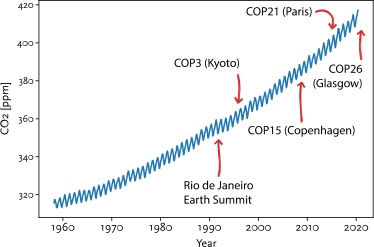
Consider annotating Keeling’s famous time series of atmospheric CO2 with a few of the more prominent United Nations Framework Convention on Climate Change conferences. Given the empirical record, how is it possible that our governing institutions and experts alike are able to maintain, decade after decade, the stable narrative that, by doing “more of the same”, in the matter of a few short years, “we” will at last solve the problem of climate change?
Or consider the now vogue policy legend of “circular economy”—a sort of economy that internally recycles all the resources it needs such as to obtain a decoupling of economic growth from the need of resources and any associated environmental impacts. Not only does this solution contradict the laws of thermodynamics, it flies in the face of common sense. In the fable of Baron Munchausen, the idea of un-entrenching oneself from a swamp by pulling one’s own hair was used to make people laugh. Now the grand plan, “the solution” endorsed by the official establishment, is that our economy will keep growing without needing resources and without stressing the environment just by eating its own excreta (“circular economy”). How is it possible that this idea can flourish unchallenged in all documents and plans dealing with sustainability?

Unless great care is taken to avoid frivolity, work in the field of sustainability science risks amounting to nothing more than “painting roses red”. As professionals who have dedicated their lives to the field of sustainability science, trust us when we say there is indeed a lot of “rose painting” at present. A sort of macro-scale occupational therapy is ongoing, understood as necessary in order to soothe societal worries. The message that “scientific rose painters” are being tasked with sending is clear enough: everything is under control, we have the solutions. What’s more, we are confident that soon we will develop still better solutions—sit back and enjoy the ride!

The unfortunate, painful truth is that sustainability science is now used, all too frequently, to suppress uncomfortable knowledge and stabilize the official storytelling. It is used to generate a cathartic trust in the dream that, through perpetual economic growth, sooner or later “all our problems will be fixed”. To be clear, we are certainly not claiming there to be some sort of underlying conspiracy theory at play. What is currently ongoing could better be diagnosed as ancien régime syndrome. Look no further than our attachment to the modern epoch, pompously called the Anthropocene, which is by all indicators looking to be hurdling to a close. The systemic elimination of uncomfortable knowledge from the discussions of policy relevant issues can be seen as a major contributor to ancien régime syndrome, it and its aggressive mobilization of expectations, its formation of difficult to question socio-technical imaginaries.
In policy discussions at the moment, we are fed a diet of rosy scenarios framed within Armageddon-type situations in which we are forced to believe that “the establishment knows what the best thing to do is, and for sure they will do it”. This is a problem.
Want to know more about our solution?