
Our Solution
Perhaps it is time to drop the pompous use of the term Anthropocene in sustainability discussions. Geological epochs span on time scales of millions of years, whereas it is difficult to imagine that the Anthropocene will last longer than the Roman Empire did. This has been an epoch in which human culture has stood infatuated with the Cartesian dream of prediction and control, an epoch in which humans—using the indications given to them by their markets and the power of their captivating technologies—actually believed that they could rule over nature. What’s holding us back from reimaging our rightful place, from living within limits? What’s preventing us from transitioning to a new era in which we re-appreciate the key role of emotions, affective interactions, fears, feelings, and so forth, in determining the meaning of our social practices. Perhaps it is time we move to an era of caring economies.
Such a transition would require action on at least two fronts.
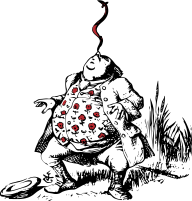
On the scientific front, it would be important to move from the Cartesian Dream of prediction and control to the complexity frame of reference. Scientists should not only admit to their own ignorance, they should not have any reticence in doing so. In sustainability science, scientists cannot and should not tell society what the optimal thing to do is. And civil society would be better off not asking them to do so. Scientists can only check the quality of explanation narratives used in processes of governance, clarifying as much as possible the known pros and cons and the levels of uncertainty that can be expected—both known-unknowns and unknown-unknowns. Scientists should not take sides on policy matters, that is not their role. They could better do their job of quality assurance through the use of “via negativa”—by eliminating sloppy knowledge claims and misleading narratives from discussions. We believe that, when coming to sustainability science, we would do well to learn from the act of Father Williams balancing the eel on his nose in Alice’s Adventures in Wonderland. Responsible use of quantitative analysis requires that scientists stay, always, on the horns of the dilemma.

On the cultural front, it would be important to organize a resistance to the progressive cyborgization of our societies. It would be important to transition from normality to a post-normal stance. We must be the ones giving meaning to what we do, especially what we chose to do. Current sustainability predicaments will not be solved by tweaking business models or by introducing techno-scientific “silver bullets”. We need to “change social practices”, not “consumer behavior”; we must respect the value of nature because it is sacred and not because it has a fictitious economic value calculated in USD; the “active population” should include consideration of all persons providing care to society, not only those involved in monetarized economic activities. The list goes on. Change on the cultural front requires reimagining the role of the extended peer community as it interfaces with science and policy.
The idea behind our approach of quantitative storytelling is to present inconsistencies in the “official” storytelling adopted in policy discussions and to flag the existence of alternative stories about given policy issues that could be very relevant and are, otherwise, ignored. We believe the quantitative storytelling can prove extremely valuable in coordinating a concerted reimagination of the scientific and cultural fronts.